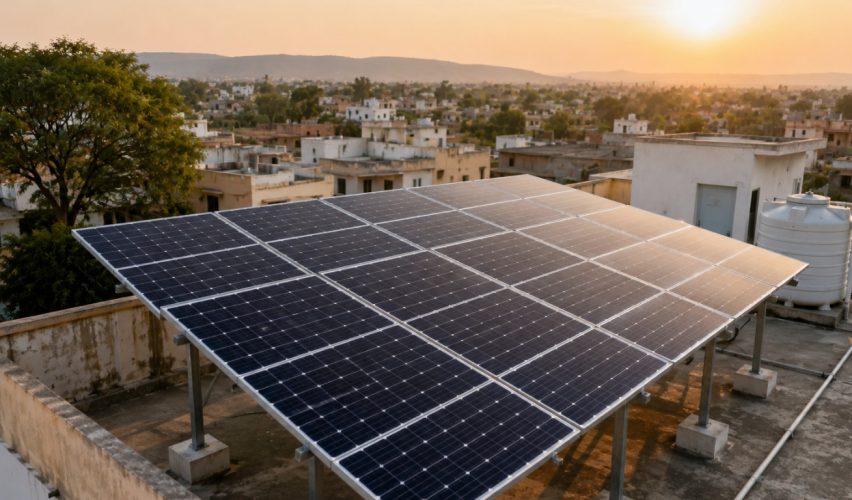
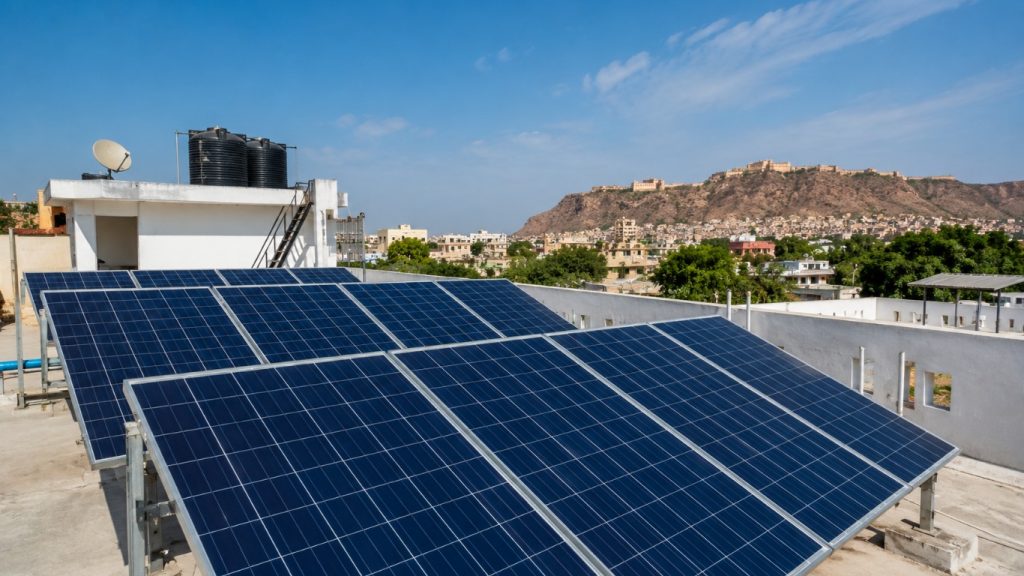
Rajasthan has entered the list of the bottom five states that are lagging in the count of rooftop solar power installations under the flagship central government initiative, Pradhan Mantri Surya Ghar Muft Bijli Yojana. The major obstacle to expanding rooftop solar is the delay in bank loans in the state. Although the solar scheme provides quicker online loan processing, almost 69,000 applications are pending at various stages.
Where Rajasthan Stands Today
Data from Rural Electrification Corporation shows that the difference between the states is huge, with Rajasthan far behind the top states:
- Gujarat has the highest number of rooftop solar installations, with 11.8 lakh.
- Maharashtra is next with 11.3 lakh installations.
- There are approximately 7.7 lakh installations in Uttar Pradesh.
- The two states have now tied for 3.2 lakh installations each.
- There are fewer than 3 lakh installations in Rajasthan.
Rajasthan has ambitious plans to deploy rooftop solar power plants in more than 5 lakh homes by March 31, 2027. The industry thinks it’s a tough goal to reach given the pace.
Why Loan Delays Are the Real Problem
The idea behind the scheme was to make the adoption of solar energy simple with speedy approval of loans through an online process. At face value, this seems to be an efficient process. On land, the situation is quite different.
Renewable Energy Association of Rajasthan president Ajay Yadav pointed out that the state needs to complete around 2 lakh more rooftop solar installations in the next seven months. He said that this is a big issue, with over 69,000 loan applications pending.
In many instances, consumers are still required to provide documentation and go to bank offices several times. In some cases, consumers are still asked to send documents again and again and visit bank offices more than once. If the way we work is still antiquated, an online application system is not the answer.
What the Industry Wants Fixed
The Renewable Energy Association has set the direction of the loan process, and there’s no doubt about it. Some modifications here may make a big difference:
- Processing ought to be truly digital—not paper.
- Approvals should be given with a time limit rather than an open-ended approval.
- It must be faceless and avoid repeated visits to the branches.
- Document verification should be a single-step process, not a round of steps.
Why This Matters Beyond Rajasthan
The installation of rooftop solar systems can be directly linked to the household electricity bills and the long-term savings. If these loans take weeks to be approved, the homeowners are disheartened and give up on waiting and go back to their regular power connection.
It’s a missed opportunity for a state that gets so much sunshine all year long. When the loan process aligns with the scheme promises, Gujarat and Maharashtra are proving to be a success.
A Few Questions Worth Asking
- When there is already a paper loan process, why do consumers continue to go to the bank branch several times?
- Does it make sense for Rajasthan to add 2 lakh installations in 7 months if the backlog hasn’t been cleared?
Conclusion
The only thing that limits Rajasthan’s solar aspirations is the demand and sun. They are restricted from doing so by a loan approval system that has not kept pace with the scheme as described in writing. If banks continue to do things the same way, with a “time-bound” and “faceless” experience, the pending numbers will continue to rise faster than the number of new installations.
These solar installation loan delays should be taken into account when homeowners are making decisions about solar time. Watch banks for developments in the next few months, as the rate at which loans are being cleared will determine whether Rajasthan can fill this gap.