
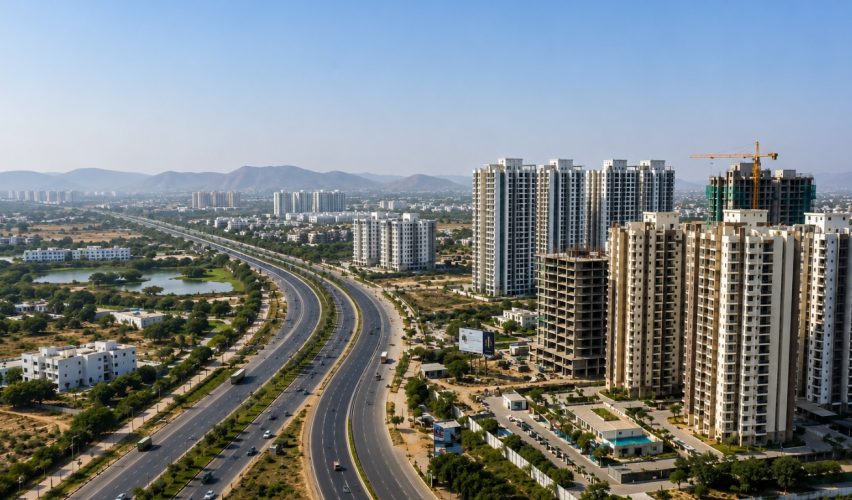
Jaipur is growing in a radial manner. It’s the one single reason why the Ring Road is the single biggest reason. Formerly peaceful neighborhoods on the outskirts of the city are now attracting developers, home buyers, and companies. For those who are monitoring the new projects in Jaipur, the ring road area is the hub of major events in 2026.
The reason is that it is necessary to understand what this infrastructure provides.
1. The Logic Behind Ring Road-Led Growth
All the major metropolises in India are similar. Land values along a ring road or bypass quickly begin to rise after it reaches functional maturity. That’s because it is very simple. Travel time shrinks. What was once daunting becomes attainable. Employers, retailers, and developers revisit locations that they previously couldn’t take into account.
2. This is the point of transition where Jaipur is now
The Ring Road is a circular road that runs through the city of Ajmer, connecting the various roads in the city, such as Ajmer Road, Delhi Bypass, Agra Road, and Tonk Road. Every junction is considered a growth node of its own. Development is going in a different direction at each node.
3. Ajmer Road Stretch: IT and Residential Convergence
The western corridor, along Ajmer Road, has been gathering momentum for a number of years. The Mahindra World City SEZ is the key to this zone providing employment opportunities in the IT and manufacturing sectors. With growing populations comes a growing need for housing within a reasonable commuting distance.
Builders have responded. All these features are engaged within this belt, such as gated townships, plotted schemes, and mid-segment apartment complexes. Rates of land have risen but not too much compared to central Jaipur.
4. Tonk Road and Sitapura: The Southern Push
Sitapura is the backbone of industries in Jaipur. The southern part of the Ring Road links this area to other areas of the city in a more efficient manner, minimizing logistical barriers for businesses and residents and enhancing their daily mobility.
This has created a greater demand for residential development on Tonk Road and beyond, leading to a steady rise in the population of the region. This has made the area around Sitapura and beyond around Tonk Road increasingly desirable for residential development, with a gradual increase in population. One important segment of buyers here includes young working professionals. The developers are planning to construct compact units in close proximity to job centers that are affordable.
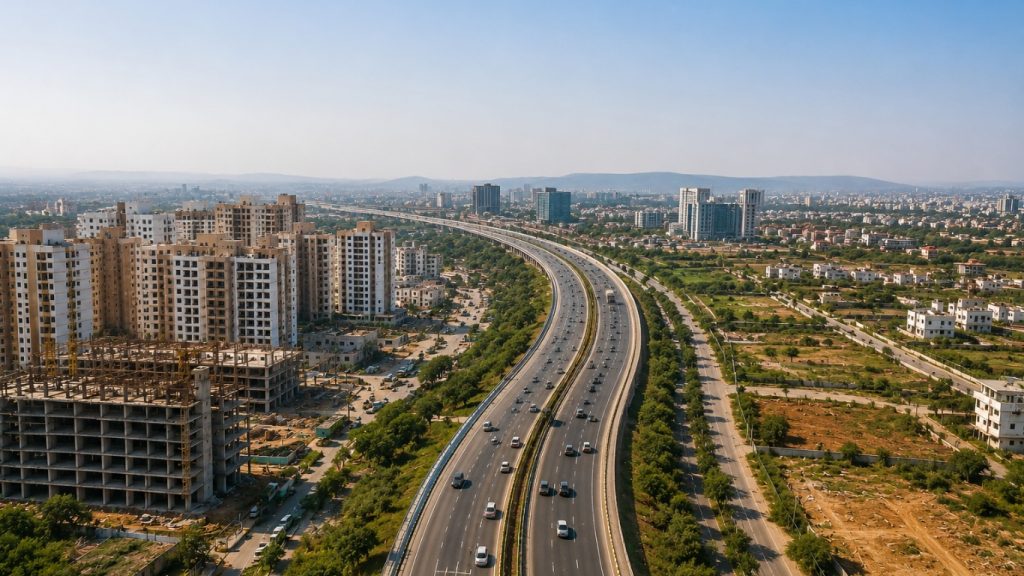
5. Agra Road Corridor: Affordable Housing With Real Connectivity
The eastern stretch is unique among the more visited corridors in providing affordable access to the city center without isolation.
Those who couldn’t afford the central and western parts of the current Jaipur rates and are thinking about buying something elsewhere are finding Agra Road has become the quickest link to the rest of the city. In the same way, new commercial projects in Jaipur are beginning to follow this residential base, with neighborhood retail and service-sector development filling in the gaps.
This corridor is at a fairly early point on its growth curve, so entering the corridor is not prohibitive of price.
6. Delhi Bypass and Northern Belt: Logistics and Plotted Development
The route going north towards Chomu and the Delhi Highway junction is attracting a new kind of investor. It is currently used for warehousing, cold storage, logistics parks, and light industries. Plotted development is still the most popular product for residential buyers.
The land acquisition activity continues at a pace that appears to be a positive rate when compared to the rate observed in other cities in Rajasthan after the complete maturity of the comparable Ring Road land acquisition activities.
7. What Separates a Good Investment From a Risky One
Just proximity to Ring Road does not ensure returns. Before considering any new launched project in Jaipur in these corridors, ask the following:
- Is the project registered in RERA, and is it visible on the Rajasthan RERA portal?
- Which is the closest entry point to the Ring Road, and how many minutes away is it?
- How is the developer’s track record with other projects?
- Do schools, hospitals, and regular retail stores currently exist, or do they still need to be built?
- What is the master plan’s take on allowed land use for that particular area?
The approach of buying early in a growth corridor is successful on a strong underlying basis. It’s not a serious option if the only factor is where.
8. The Window That Exists Right Now
Phases in Growth Corridors. When a buyer has the awareness phase, the only one who acts has the information. During the momentum phase, prices make rapid movements and inventories become small. During this maturity stage, the benefits are predominantly completed.
Currently, most Jaipur Ring Road corridors are in the awareness and momentum phase. It’s in that space where value is created.
Conclusion
The Jaipur Ring Road is systematically releasing parts of the city that it could not absorb. This section is where both residential and commercial activity and investor interest are coming together in 2026. But first-time buyers or investors, who are looking for affordability or appreciation, should definitely consider the new projects in Jaipur along the Ring Road. Visit bigsauda.com, where you can search for properties that have been verified by location along all the active corridors, and you will be able to find the opportunity that best suits your goals.