
The excitement of owning a home in Jaipur is only a fleeting moment, and when you see the registration documents on the table, you realize that the cost of the home isn’t the only thing you have to pay.
It’s easy to see that stamp duty and registration fees really do make a dent in your wallet, and if you get lazy with the math early on, it can lead buyers off the straight and narrow path. When someone is looking for flats, plots, and villas for sale in Jaipur, this is a question that we receive from almost everyone. Here’s a clear explanation to help you plan accordingly.
Stamp Duty Rate for Men vs Women
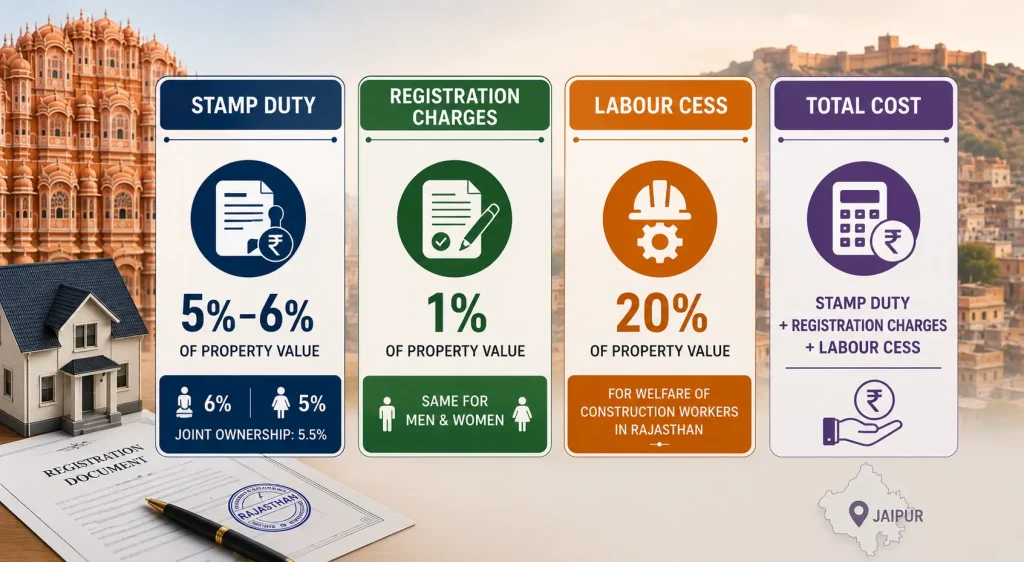
The stamp duty is different according to the gender of the buyer in Rajasthan. Males pay 6% of the value of the property. Women pay 5%, which is a 1% rebate for women to promote ownership of homes. The average joint ownership is approximately 5.5% between husband and wife.
Registration Charge
In addition to stamp duty, all buyers must pay a 1% registration fee based on the property’s value. There is no gender-based variation here, as this remains the same for men and women.
Labour Cess
Labor cess can come as a surprise to buyers. It is not the stamp duty amount but 20% of the property value, and it is contributed to welfare schemes for construction workers in the state of Rajasthan.
Full Calculation Example
Curious about how the process works for an actual transaction? Let’s look at two popular price points from the math:
If the property is worth 50 lakh, then:
- Male buyer: stamp duty 3 lakh, labor cess 60,000, registration 50,000, total 4.1 lakh.
- Male buyer: stamp duty 2.5 lakh, labour cess 50,000, registration 50,000, total 3.5 lakh
If the property is 1 crore, then:
- Male Buyer: 8.2 lakh (stamp duty 6 lakh, labour cess 1.2 lakh, registration 1 lakh)
- Male buyer: 10 lakh stamp duty + 1 lakh labor cess + 1 lakh registration = 12 lakh.
How to Pay Online via E-Panjiyan Portal
The Rajasthan government is operating the E-Panjiyan portal for paying stamp duty and registering the document. The e-stamp is generated online, and the buyer will fill out the property and buyer details and book a sub-registrar slot as well without leaving their home and pay the e-stamp through net banking or card. This avoids the need for multiple trips to the office and helps to reduce the risk of mistakes in paperwork that are often associated with filing manually.
Exemptions Worth Knowing
Women are already entitled to a 1% concession (as mentioned above). At present, elderly people and those with disabilities are eligible for extra rebates, subject to proof of disability and age at registration, per the state’s notification. The duty is also low in case of family transfers, such as by gift deed, between blood relatives, such as parents, children, or spouses. Please consult the current circular before assuming that you are eligible for these benefits, as they do change periodically.
Save Stamp Duty Legally: Tips
Here are a few legal ways our team at BigSauda suggests to buyers:
- If possible, register the property in the wife’s name to take advantage of the 5% rate.
- In the agreement, include furniture and fittings, as this does not apply to stamp duty.
- Consider using gift deeds for transfers within a close family for concessional rates
- Please consult the DLC rate for your area first, as duty shall be based on the highest rate.
Conclusion
With a little planning, each Jaipur property deal can save real money. When signing anything, keep the numbers with you; go and check the official portal for the latest rates and have a buffer for stamp duty, cess, and registration separate from the sale price. After sorting out your budget, go through the verified listings on bigsauda.com for a home that will fit even after these statutory charges.
References
Inspector General of Registration and Stamps, Rajasthan (IGRS) official portal, Rajasthan Stamp Act, 1998, E-Panjiyan portal, Government of Rajasthan
Disclaimer: Stamp duty rates, labour cess, exemptions, and portal procedures are set by the Rajasthan government and can change through fresh notifications. This article is for general guidance only and is not legal or financial advice. Please verify current rates and eligibility on the official IGRS Rajasthan or E-Panjiyan portal, or consult a property lawyer, before making payment.