

India’s solar sector is bracing for a significant cost shock.
A new government mandate requiring all solar project developers to source cells exclusively from approved Indian manufacturers — effective June 1, 2026 — is expected to push solar project costs up by over 30%, according to industry representatives in Rajasthan.
If you’re an investor, a rooftop solar buyer, or tracking the renewable energy space, here’s what’s happening and why it matters.
What Is the DCR Mandate?
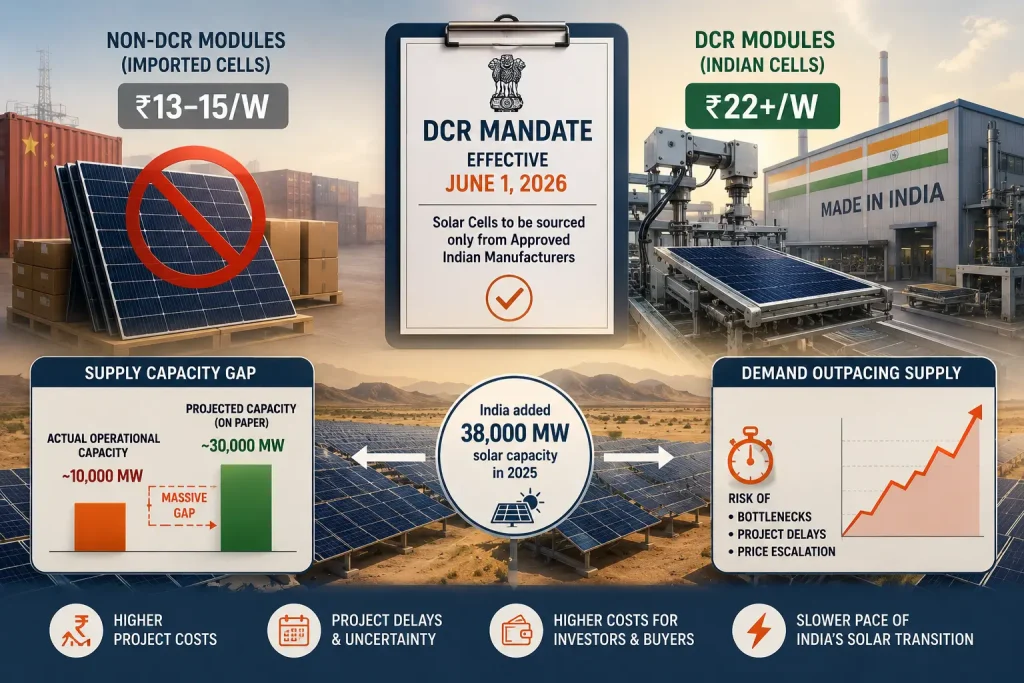
Under India’s Domestic Content Requirement (DCR) framework, solar project developers must now procure solar cells only from approved domestic manufacturers. Solar panels assembled using cheaper imported cells — previously the industry norm — are no longer permitted.
The policy is part of the center’s broader push to build indigenous manufacturing capability and reduce India’s dependence on imported solar components, primarily from China.
The Price Gap Is Stark
The cost difference between DCR and non-DCR modules is not trivial:
- Non-DCR modules (made with imported cells): Rs 13–15 per watt (wholesale)
- DCR modules (made with Indian cells): Rs 22 per watt or more
That’s a premium of nearly 50–70%, driven by higher domestic manufacturing costs and limited cell availability. Industry leaders warn that DCR module prices could climb even further since the market is highly concentrated—currently just five to seven manufacturers supply DCR-compliant cells domestically.
Supply Capacity: The Core Problem
On paper, India’s domestic solar cell manufacturing capacity is projected at nearly 30,000 MW. In reality, the actual operational capacity is estimated at only around 10,000 MW—a massive gap when you consider that India added 38,000 MW of new solar capacity in 2025 alone.
With demand far outpacing domestic supply, the risk of bottlenecks, project delays, and further price escalation is real.
Industry Is Asking for a Pause
Sailesh Garg, Vice President of the Rajasthan Solar Association, put it plainly:
“While we support the center’s push to promote native cell manufacturing, the short deadline will push up solar panel prices by over 30%. Manufacturers have little time to scale up production to meet demand, and this could dent consumer interest.”
Garg also called for the central government to commission an independent assessment of existing DCR module manufacturing capacity and actual demand before enforcing the deadline—to avoid disrupting the market unnecessarily.
The ripple effects aren’t limited to panels alone. Ancillary industries — manufacturers of frames, junction boxes, and other solar components — may also be forced to scale down production if project pipelines slow.
Who Gets Hit?
- Rooftop solar buyers under PM Surya Ghar Yojana will face higher upfront costs.
- Industrial and commercial clients who rushed to order non-DCR panels before June 1 will find fewer affordable options. going forward
- Project developers may see timelines stretched due to limited domestic cell supply.
- Investors in solar EPC and module companies should factor in demand uncertainty and margin pressures in the near term.
The Bigger Picture
India’s solar ambition is massive — and self-reliance in cell manufacturing is a legitimate long-term goal. But the transition timeline matters. A mandate without adequate domestic supply infrastructure is a recipe for cost inflation, project delays, and dampened adoption — all things that could slow the very energy transition the policy aims to accelerate.
The coming months will be a critical test: can India’s handful of domestic cell makers ramp up fast enough to meet the country’s booming solar demand—or will costs keep climbing while the gap between policy and capacity persists?
Watch this space.
Sources
- “Solar project costs in Raj likely to go up 30% with local-cells-only policy”—Srikanta Tripathy, Times of India, June 2026. timeofindia.com
- “Independent DCR review by center sought before deadline”—Times of India, June 2026 (Continued from P1, Jaipur edition)
BigSauda.com covers markets, money, and the stories that move them. This article is for informational purposes only and does not constitute financial or investment advice.