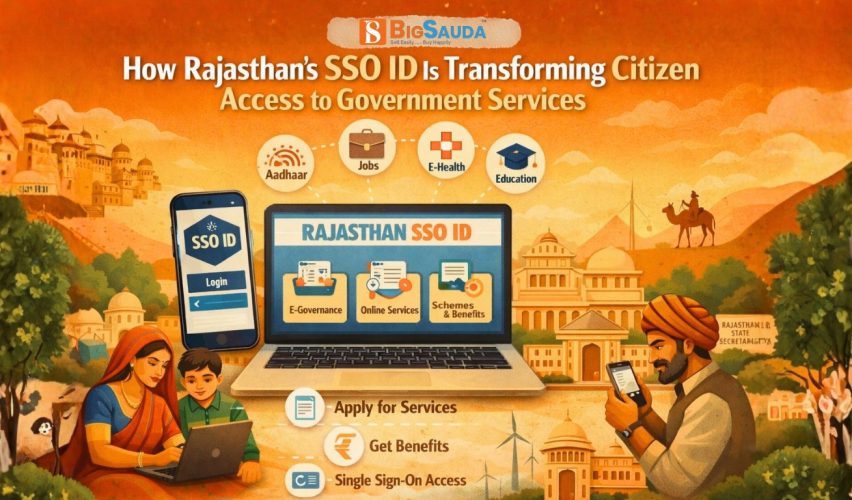
Citizens in the modern digital age desire quick, open, and convenient services in the government. Long queues, completion of repetitive forms and going through several departments are gradually turning into a thing of the past. The SSO ID (Single Sign-On ID) system is one of the largest sources of this change in Rajasthan.
This is what the SSO ID of Rajasthan is transforming the public service delivery, and why it is now being used as an example of digital governance in India. In case you are an individual who often monitors government news and opportunities, you can also use such sites as bigsauda to be aware of what popular services and schemes are trending.
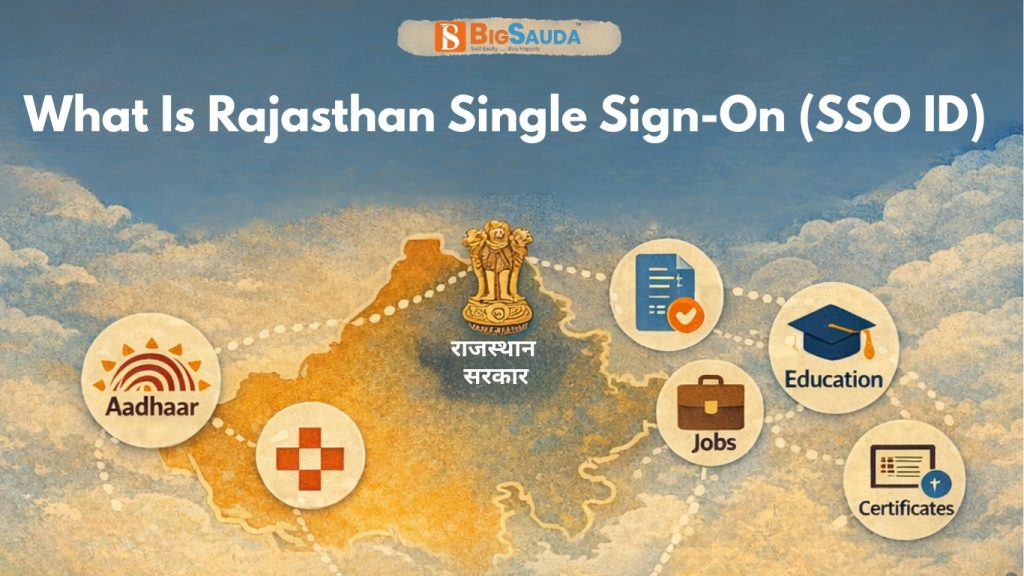
1- What Is Rajasthan Single Sign-On (SSO ID)?
Rajasthan SSO ID is a unified digital platform introduced by the Government of Rajasthan itself that enables citizens, business, and government employees to get access to various government services with one unique access credential.
Rather than having to open different accounts based on the department, users can use the same account and access dozens of services using all services in a central dashboard.
2- The reasons as to why Rajasthan Introduced SSO ID
- Prior to the introduction of SSO ID citizens used to encounter:
- Various usernames and passwords
- Delay in documentation
- Limited transparency
- The state government was seeking to streamline the services offered to people and support digital governance through programs such as Digital India. The result? One online identity to enable easy access to services.
3- Among the important services offered by SSO ID there are the following:
The Rajasthan SSO portal has over 100 government services such as:
1. e-Mitra Services– Article bills, certificate applications and other local services.
2. Recruitment and Job Application– Government jobs are applied via websites such as Rajasthan Subordinate and Ministerial Services Selection Board (RSMSSB).
3. Business Registration– Businesses can be registered and a license requested by the entrepreneurs without having to go to various offices.
4. Scholarship and Education Services– Students have an opportunity to get scholarship and monitor status of applicants online.
5. Utility Bill Payments– Payments of electricity, water, and other payments to the public services can be made directly via the portal.
The centralized structure has also minimized a lot of paper work and waiting time.
4- The citizen access is being transformed with SSO ID
1. One Login, Multiple Services– The greatest benefit is convenience. There is no longer the need of different credentials in citizens by different departments.
2. Paperless System and Time-Saving.- Applications are now completed online where most applications can be done online saving paper work and travel expenses.
3. Support for Businesses– Simplified compliance and registration process are favorable to startups and MSMEs.
5- Challenges and Future Scope
- Although the system was highly valued, it can be still improved:
- Digital disparities in the rural areas.
- Dasher technical glitches here and there.
- More awareness campaigns are required.
As upgrades and development of infrastructure continue, the SSO platform in Rajasthan can be developed as one of the most advanced state-based digital ecosystems in India.
6-The reason why Citizens should adopt SSO ID
you are missing the opportunity to enjoy streamlined access to government services in the state of Rajasthan, provided that you do not have your SSO ID yet. It saves time, it is less stressful and government services are in the tip of your fingers .In the case of people following government schemes, updates on recruitment, and services-related opportunities, such sites as bigsauda may serve as an addition to your digital experience in order to be aware of trending updates and helpful materials
Conclusion
The SSO ID of Rajasthan is not just a system of logging in but a big step towards digital empowerment. It has made life easier by harmonizing access to government services to millions of citizens, businesses and students. With the ongoing development of technology, such projects as SSO ID testify that the digital governance is no longer a future phenomenon, but the present one.